
Solar Inverter MPPTs: What the Number on a Quote Means
Learn what MPPTs do, why roof layout matters and which practical questions to ask before comparing solar inverter quotes.
 Randy Osifo-Doe
Solar inverter MPPTs can appear as a small specification on a quote, but the number only becomes useful when it is matched to the proposed roof layout. It is not a simple score where more always means better.
The practical question is how the installer plans to group your panels. Different roof directions, tilts and shading conditions can create different operating conditions, so the inverter and panel layout need to work as one design.
What an MPPT does
MPPT stands for maximum power point tracking. In a string-inverter system, it is the control function that adjusts the operating point of the connected panel group as sunlight and temperature change. A tracker works with the panels assigned to it; it does not make every panel behave independently.
The Australian Government's inverter guidance defines a string as a group of panels connected together. It also says panels under similar sunlight and shading conditions generally perform better when they are connected in the same string.
That distinction matters. A quote can name an inverter with 2 or 3 MPPTs, but the headline number does not show which roof face or string will use each tracker.
Why your roof layout matters
A simple unshaded roof face presents a different design problem from a roof split across east, north and west. The Australian Government notes that a string inverter may not be the best option where panels sit on more than 3 roof sections with different slopes and directions, or where there is substantial shading.
This does not mean every roof face automatically needs its own MPPT. It means the installer should be able to explain the grouping, including any design rule or inverter limitation behind it. If shade is the concern, start with the solar panel shading checklist before assuming extra hardware is the answer.
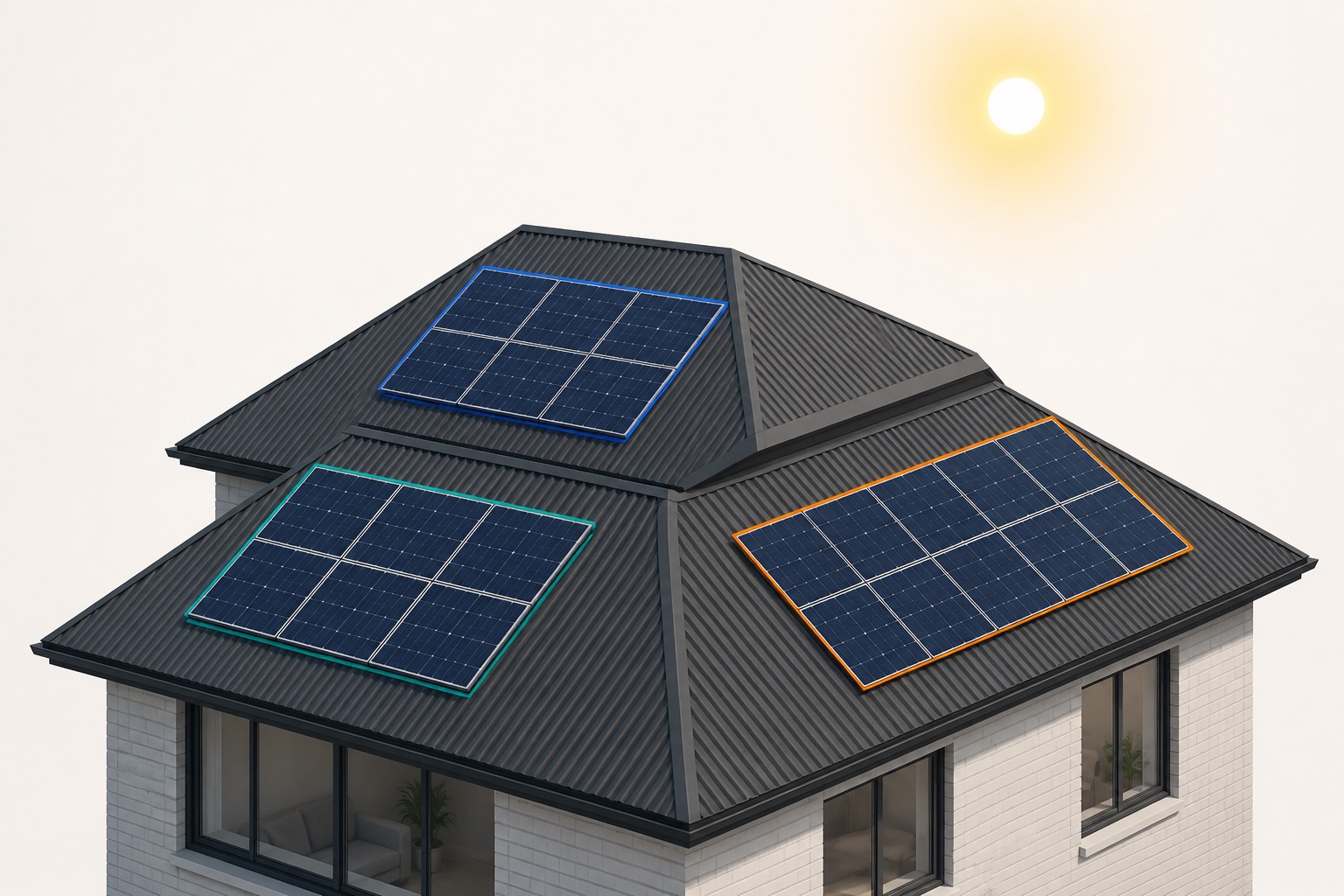
The coloured outlines separate the 3 roof-face groups for explanation only. They are not a wiring or installation diagram.
MPPTs, strings and inputs are not the same thing
These terms are often placed together on an inverter data sheet, but they answer different questions.
| Quote detail | What it tells you | What to ask |
|---|---|---|
| Roof layout | Where each panel group will sit | Which groups face different directions or receive different shade? |
| String layout | Which panels are electrically grouped | How many panels are in each string? |
| MPPT count | How many independent tracking channels the inverter provides | Which string or roof group is assigned to each MPPT? |
| DC inputs | The available connection points on that inverter model | Are any inputs shared, unused or reserved under this design? |
The Clean Energy Council's solar PV maintenance checklist records the number of panels, orientation, tilt and MPPT number for each string. That is a useful clue for homeowners: ask for the proposed mapping, not just the equipment name.
How to compare 2 solar quotes
Put the roof plans beside each other and ask each retailer the same questions:
- How many roof faces and distinct shading conditions are in this design?
- How many strings are proposed, and which panels belong to each string?
- Which MPPT will each string use?
- If 2 different roof groups share a tracker, what design assumption makes that suitable?
- Does the final inverter model and panel layout match the written quote?
The Australian Government says a quote should include the inverter make and model plus a site-specific design showing panel and inverter locations. Solar Victoria's quote guidance also recommends checking the proposed roof layout and the inverter type and size. If the answer stays at “the inverter has enough MPPTs” without showing the grouping, the design is still hard to compare.
When fewer MPPTs may still be reasonable
An uncomplicated roof with panels facing the same direction and receiving similar sunlight may not need many independent trackers. A more complex roof may need a different string arrangement, more tracking channels, or a panel-level approach such as microinverters or optimisers.
This is where I think homeowners need to slow down. Paying for a larger specification is not the same as paying for a better-matched design. Read the microinverter versus string inverter guide and the power optimiser quote guide if those alternatives appear in one proposal.
What to check next
Ask the retailer to mark each string and its MPPT assignment on the roof plan or provide a separate design sheet. Then check whether the generation estimate uses that same layout and shading assumption with the solar generation estimate guide.
You do not need to design the electrical system yourself. You only need enough clarity to see whether 2 quotes solve the same roof problem in the same way.
Sources checked
Last reviewed August 2026
This guide is reviewed against current Australian solar policy and market guidance where available. Confirm retailer prices, rebates, and product eligibility before making a purchase decision.
Randy Osifo-Doe is the Brisbane-based founder and lead writer of Aussie Solar Guide. His background is in finance, banking and household budgeting, and he writes from lived experience as a solar homeowner. He is not presented as an engineer, electrician, solar installer or renewable-energy professional.