Solar Panel Shading: What to Ask Before You Sign
Use this practical checklist to compare shade-aware solar layouts, generation assumptions and installer explanations before accepting a quote.
 Randy Osifo-Doe
Solar panel shading does not automatically rule out rooftop solar, but it should change the questions you ask before accepting a quote. A useful proposal should show where shade falls, explain how it affected the layout and make its generation assumptions clear.
Shade is rarely fixed in one place. A tree, chimney, neighbouring building or antenna can affect different roof areas as the sun moves, and the pattern can change with the season. That is why a photo taken at one time of day is helpful but not a complete shade assessment.
Start with a site-specific shade picture
The Australian Government's solar design guidance says the amount of shade depends on the position and height of the obstruction, the time of day and the season. It also notes that a little shade is not necessarily a problem, while long periods of shade can reduce generation enough to affect whether a design is worthwhile.
Ask the retailer to mark the likely shaded areas on the proposed panel layout. The discussion should cover existing trees and buildings as well as things that may change, such as tree growth or a planned neighbouring development.
For an independent starting point, compare the quoted layout with a roof estimate from the solar calculator. Treat any online result as a planning aid: the installer still needs to explain the site-specific design used in the quote.
Compare the assumptions, not just the panel count
Two quotes can fit the same number of panels while making different choices about which roof sections to use. Ask each retailer to explain:
- which panels are expected to receive shade and at what times
- whether any high-shade roof area was excluded
- how shade was represented in the annual generation estimate
- whether the layout may be affected by seasonal or future shade
- what design choices were considered and why the proposed option was selected.
The Australian Government recommends getting quotes from at least three suppliers and asking for a site visit. Its retailer and installer checklist specifically identifies potential shading as a complication that an onsite review can uncover.
If a site visit is not available before quoting, ask what evidence was used: roof imagery, measurements, a shade model, your photographs or another method. A clear limitation is more useful than an unexplained precise-looking output figure.
Use one checklist for every quote
| Check | What a useful answer includes |
|---|---|
| Shade source | The tree, building or roof object causing it |
| Timing | The relevant time of day and season, not just “some shade” |
| Layout response | Which roof areas were used, avoided or separated |
| Estimate | How shade was included in expected generation |
| Future change | Tree growth, pruning assumptions or planned obstructions |
| Handover | The final layout and assumptions recorded in writing |
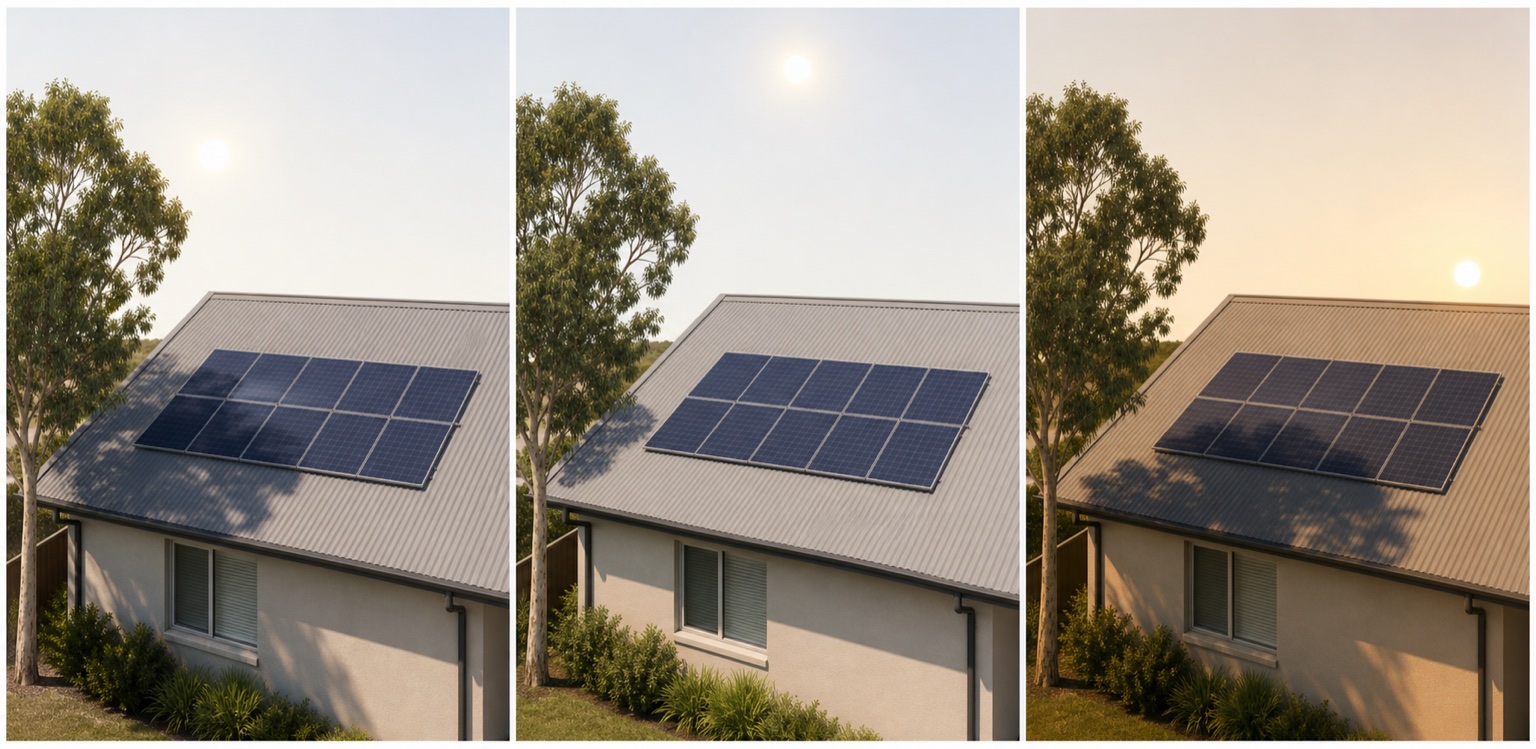
Shade can move across different parts of the same roof during the day. The illustration is a general example, not a prediction for a particular home.
Ask how the design responds to shade
Shade-aware design is not a single product choice. Depending on the roof and the pattern of shade, an installer might change panel placement, separate groups of panels electrically or discuss different inverter arrangements. Solar Victoria's system-planning guidance advises working with the installer so unavoidable partial shade has the least practical effect on the rest of the system.
Ask for the reason behind the recommendation rather than assuming one technology is always required. The microinverters and string inverters guide can help you compare the explanation without turning shade into a brand contest.
Orientation and shade are related but separate decisions. A roof section may face a useful direction yet receive afternoon shade, while another may produce across a different part of the day. Use the east-west and north-facing roof guide to frame that conversation, then ask for the actual assumptions used for your roof.
Record the answer before installation
Before signing, keep the proposed panel layout and generation estimate with the quote. Note any assumptions about tree trimming, future shading or access to the roof. If the design changes before installation, ask for the revised layout and expected output in writing.
You do not need a shade-free roof to have a useful conversation about solar. You do need an explanation you can compare. Take the same checklist to each retailer, use the broader installer quality checklist, and pause if a proposal cannot show how shade was considered.
Sources checked
Last reviewed July 2026
This guide is reviewed against current Australian solar policy and market guidance where available. Confirm retailer prices, rebates, and product eligibility before making a purchase decision.
Randy Osifo-Doe is the Brisbane-based founder and lead writer of Aussie Solar Guide. His background is in finance, banking and household budgeting, and he writes from lived experience as a solar homeowner. He is not presented as an engineer, electrician, solar installer or renewable-energy professional.