Solar Retailer Closed? Where to Start With Your System and Warranty
If the business that sold your solar system has closed, check its status, gather your records and identify the right contact for the problem.
 Randy Osifo-Doe
If your solar retailer closed, the name on your original quote may no longer lead to a working support team. That is frustrating when an inverter stops reporting, a warranty question comes up or you are still waiting for work to be finished. Start by confirming what happened to the business, then match your issue to the records and contacts you actually have.
A closed shopfront, unanswered phone or bounced email does not by itself prove the company is insolvent. The distinction matters: a business still trading under administration, a successor business and a business that has stopped trading can leave you with different practical routes. The ACCC's business closure guidance is the starting point for those differences.
Check the business status first
Find the legal business name and ABN or company number on your contract, invoice or receipt. A trading name on a van or website may not be the entity that sold you the system. The ACCC recommends checking ASIC's published notices to see whether the company is in administration or liquidation and who has been appointed. ASIC's insolvency page explains where to search and what the notices can tell you.
Also check any announcement from an administrator or a business that has bought the old operation. The ACCC says a buyer may or may not take on the previous business's liabilities. Don't assume a familiar brand or phone number means your old claim is covered. Ask for the position in writing.
If you cannot establish the status, say exactly that when you contact an official consumer agency. Avoid declaring the company insolvent based only on social posts or an unavailable website.
Put the system record together
Collect the accepted quote, proof of payment, invoice, final design, handover documents, panel and inverter model details, serial numbers you already have, and each warranty document. Save emails about any previous fault or unfinished work. Screenshots of a monitoring warning can help explain a current problem, but they do not establish its cause.
Keep the seller's promises separate from the product manufacturer's document and any installation workmanship promise. Our solar warranty checklist explains what each document normally covers. If you moved into the home after installation, the moving house solar guide helps you identify missing system records.
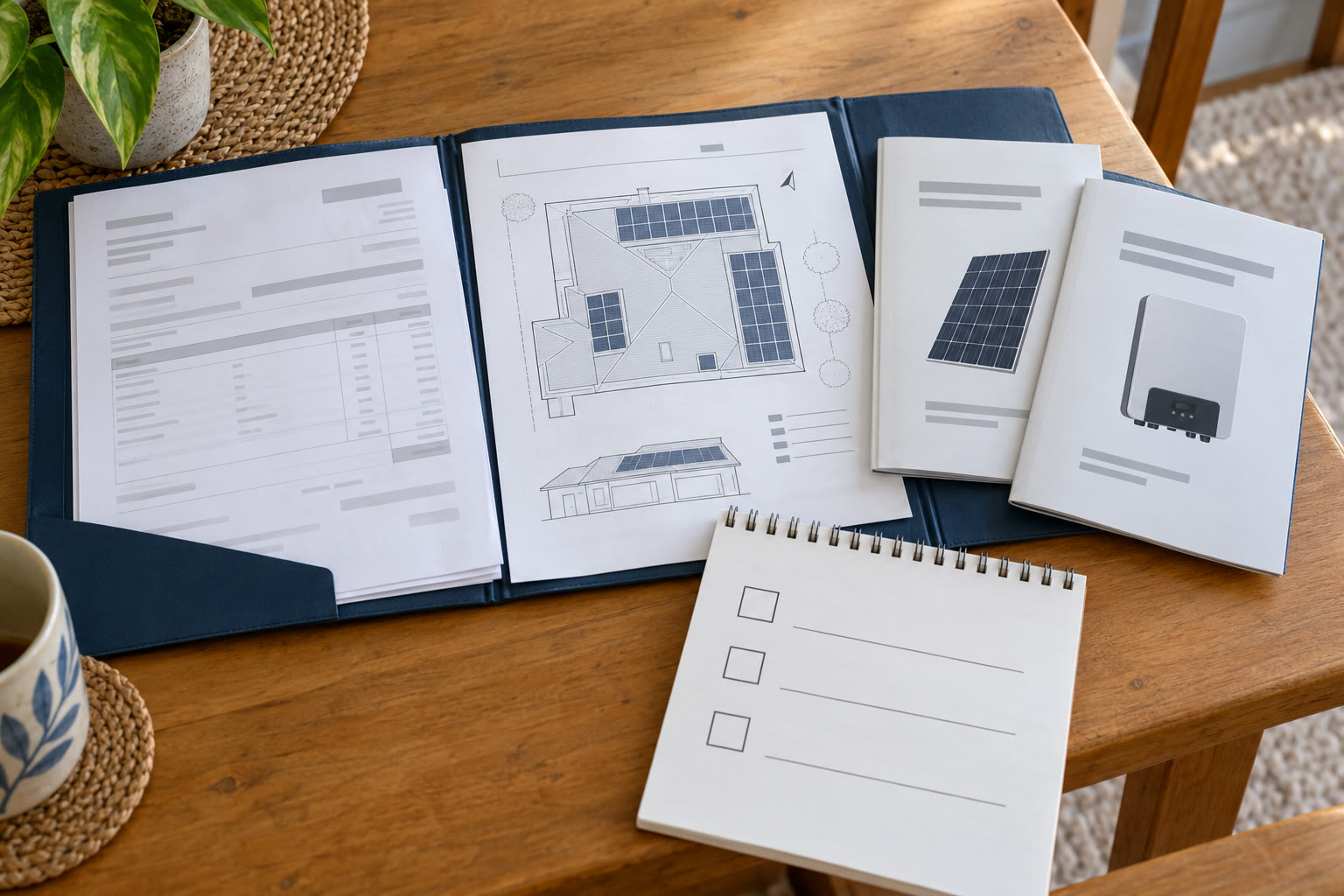
Gather the documents you already hold. The illustration does not represent a real warranty or prove that a particular claim is covered.
Match the problem to a next contact
| What you need to resolve | Useful first check |
|---|---|
| The business is still trading under administration | Read the administrator's announcement and ask how existing customers should lodge the issue. |
| A panel or inverter product appears faulty | Check the exact manufacturer and product warranty; the ACCC says a separate manufacturer may be a contact if the seller has gone bust. |
| Installation work or promised aftercare is in dispute | Gather the contract and workmanship terms, then ask the administrator or a state or territory consumer agency about the available path. |
| You paid for work or equipment not delivered | Check the administrator's instructions promptly. If you paid by card, loan or payment provider, ask that provider whether a payment reversal is available and its time limit. |
These are starting contacts, not a finding that a claim will succeed. The ACCC says insolvency can affect rights under warranties and consumer guarantees, and the outcome depends on the circumstances. Its solar and home battery guidance confirms consumer guarantees can apply to these products; it does not decide your individual remedy.
Keep a fault separate from a business problem
If the system is showing a warning or generating less than expected, record what you can see safely. Do not open electrical covers or attempt to identify a failed component yourself. The solar monitoring guide helps you describe the pattern, while the maintenance guide explains when to seek a qualified assessment.
An independent diagnosis may clarify whether the issue concerns a product, installation work or something else. Before paying for a repair, ask the assessor to record the finding and ask any relevant warranty contact what evidence it needs. Do not assume a new installer will honour another business's workmanship promise.
Use official help for the unresolved claim
The Australian Government's solar dispute guide lists the usual escalation paths, including state and territory consumer protection agencies. The ACCC can take reports but says it does not resolve individual disputes or give legal advice. ASIC provides information about insolvent companies and their administrators; it does not decide your solar claim.
Write down the legal business name, what you bought, what went wrong, what you have already asked for and every response. This is where I think a clear paper trail matters more than trying every phone number at once. Begin with the verified business status and the exact product or work at issue, then ask the appropriate contact for a written next step.
Sources checked
Last reviewed October 2026
This guide is reviewed against current Australian solar policy and market guidance where available. Confirm retailer prices, rebates, and product eligibility before making a purchase decision.
Randy Osifo-Doe is the Brisbane-based founder and lead writer of Aussie Solar Guide. His background is in finance, banking and household budgeting, and he writes from lived experience as a solar homeowner. He is not presented as an engineer, electrician, solar installer or renewable-energy professional.