
Solar Warranty Checklist: What to Get Before You Sign
Use this practical checklist to separate solar product, performance and workmanship warranties and confirm who handles a future claim.
 Randy Osifo-Doe
A solar warranty checklist helps you compare what happens after installation, not just what the sales page promises. Before accepting a quote, collect the actual documents, separate the different types of cover and confirm who will help if a panel, inverter or installation detail develops a problem.
The goal is not to choose the longest headline period. It is to understand the written terms, the exclusions and the claim path while the retailer is still easy to contact.
Start with three separate warranty documents
Solar quotes often place several warranties in one summary. Ask for the full documents that apply to the exact equipment and installation in your proposal.
| Warranty document | What to confirm in writing |
|---|---|
| Product warranty | The exact panel, inverter or battery model covered, the start date, exclusions and available remedy |
| Performance warranty | The output level promised over time, how performance is measured and what happens if the threshold is not met |
| Workmanship warranty | The installation work covered, the responsible business, exclusions and how an inspection is arranged |
The Australian Government Solar Consumer Guide explains that product, performance and workmanship warranties cover different things. A long performance period does not replace a clear product warranty, and a product document does not explain who fixes installation workmanship.
Use the broader installer quality checklist to check credentials and after-sales support alongside these documents.
Match every document to the quote
Compare the model numbers in the warranty documents with the panel and inverter models listed on the quote. If the quote uses a bundle name or says “equivalent model”, ask the retailer to specify what will actually be installed and which document applies.
Also check who issued each warranty. The panel manufacturer, inverter manufacturer, solar retailer and installer may have different roles. Write those roles down instead of assuming one contact will handle everything.
If you are still comparing system designs, the microinverters and string inverters guide shows why inverter choice, access and support should be assessed with the whole proposal.
Record the claim path before installation
Ask one practical question: “If this part fails, who do I contact first?” The answer should include a business name, a current phone or email contact, the information needed to start a claim and any inspection or transport steps.
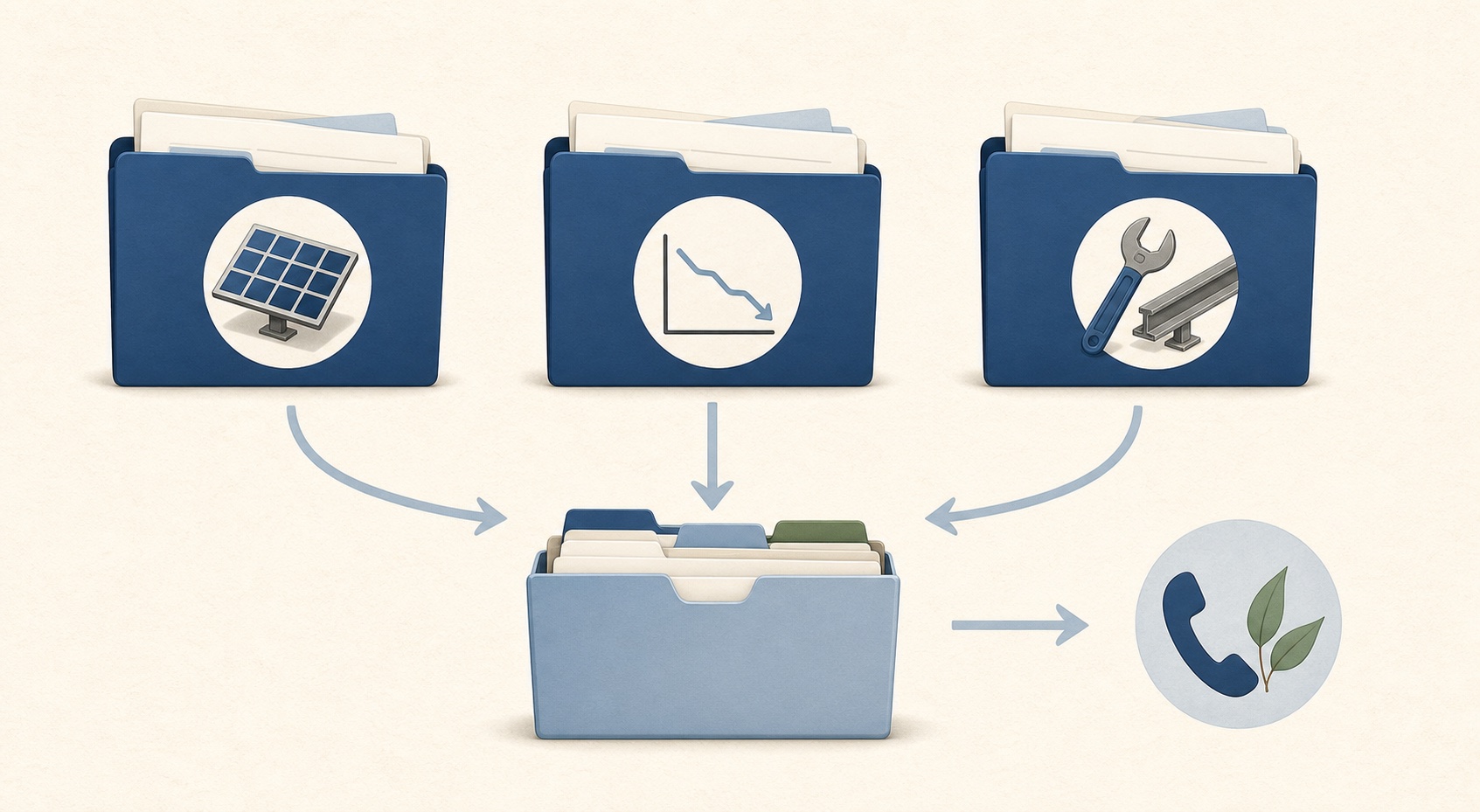
Keep the product, performance and workmanship documents together, but record the responsible contact for each one. The icons are illustrative and do not represent a specific brand.
Save copies of the accepted quote, final system design, invoices, serial numbers, installation handover information and warranty documents somewhere you can access if the original email account or app changes.
Check the exclusions and ongoing conditions
Warranty terms can include conditions about installation, operating environment, registration, monitoring or maintenance. Read the actual document rather than relying on a salesperson's summary.
Use this short review list:
- Is the exact installed model identified?
- When does the warranty start, and is registration required?
- What faults, damage or operating conditions are excluded?
- Who pays for diagnosis, removal, transport, labour and reinstallation?
- Is monitoring data or maintenance evidence needed?
- Does the claim process rely on an app, overseas contact or third party?
- What happens if the retailer and installer are different businesses?
Do not infer the answer from a badge or headline. Ask for unclear terms to be explained in writing and keep that response with the quote.
Compare support, not only duration
Two quotes can advertise similar warranty periods but offer very different support paths. A useful comparison looks at the exact equipment, written exclusions, local claim contact, labour responsibilities and the steps required to restore the system.
The good solar quote guide can help you compare the warranty review with system design, itemisation and installation scope. This checklist does not replace current consumer-rights guidance; for that, use the official ACCC source below or your state consumer agency.
What to do before you sign
Create one folder for the proposal and mark each warranty item as received, unclear or missing. Send the same questions to every retailer so the answers are comparable.
If important documents are missing, pause and ask for them. When the warranty path is clear and the rest of the proposal is itemised, use the quote request to compare like-for-like offers without choosing on the headline period alone.
Sources checked
Last reviewed July 2026
This guide is reviewed against current Australian solar policy and market guidance where available. Confirm retailer prices, rebates, and product eligibility before making a purchase decision.
Randy Osifo-Doe is the Brisbane-based founder and lead writer of Aussie Solar Guide. His background is in finance, banking and household budgeting, and he writes from lived experience as a solar homeowner. He is not presented as an engineer, electrician, solar installer or renewable-energy professional.