
Solar Panel Efficiency vs Wattage: What Quotes Mean
Learn how panel efficiency, wattage, dimensions and panel count work together before comparing rooftop solar quotes.
 Randy Osifo-Doe
Solar panel efficiency vs wattage sounds like a comparison between two versions of the same number. It is not. Efficiency describes how much incoming light a panel converts into electricity, while wattage is the panel's rated power under standard test conditions.
Both figures can help you compare a quote, but neither tells the whole story. Panel dimensions, panel count, roof layout, shade and the total array size matter too. Start by separating those details before deciding that one proposal has the “better” panel.
Read the four numbers separately
The Australian Government's solar panel guidance explains that panel efficiency is a percentage and rated capacity is measured in watts. For two panels of the same physical size, the more efficient panel can have a higher rated capacity because it converts more of the light falling on that area.
Higher wattage does not automatically mean higher efficiency. A panel can also have a higher wattage because it is physically larger. That is why a quote should let you compare these four details together:
| Quote detail | What it means | Why it matters |
|---|---|---|
| Efficiency (%) | The share of incoming light converted to electricity | Helps compare how effectively equal areas are used |
| Panel wattage (W) | Rated power of one panel under standard test conditions | Used with panel count to calculate array size |
| Panel dimensions | The length and width of one module | Determines how the proposed panels fit your roof |
| Panel count | The number of modules in the design | Changes total capacity and the required roof area |
The rated figure is a comparison point, not a promise of constant output. Actual generation changes with location, weather, time of day, season, panel direction, tilt, shade, dirt and other system factors.
Calculate the array size
Multiply the number of panels by the wattage of each panel, then divide by 1,000 to convert watts to kilowatts.
For example, 15 panels rated at 440 W make a 6.6 kW array. Fourteen panels rated at 475 W make a 6.65 kW array. Those proposals have a similar total rated capacity even though their panel counts and individual wattages differ.
The calculation does not show which layout will generate more electricity at your home. Ask for the physical panel dimensions, roof plan and generation estimate as well. The Australian Government's system sizing guidance treats system size as the combined rated capacity of all panels and notes that available sunny roof area can limit the design.
If kW and kWh are still being mixed together on the proposal, use the kW versus kWh guide before comparing generation estimates.
Decide when efficiency matters most
Efficiency becomes particularly useful when good roof space is limited. A higher-efficiency module can provide more rated capacity from the same panel area, which may help a designer make better use of a small or interrupted sunny roof section.
It matters less as a headline number when there is ample suitable roof area and two designs reach the same useful array size. In that situation, compare the complete layouts, expected generation assumptions, warranties and support rather than choosing on efficiency percentage alone.
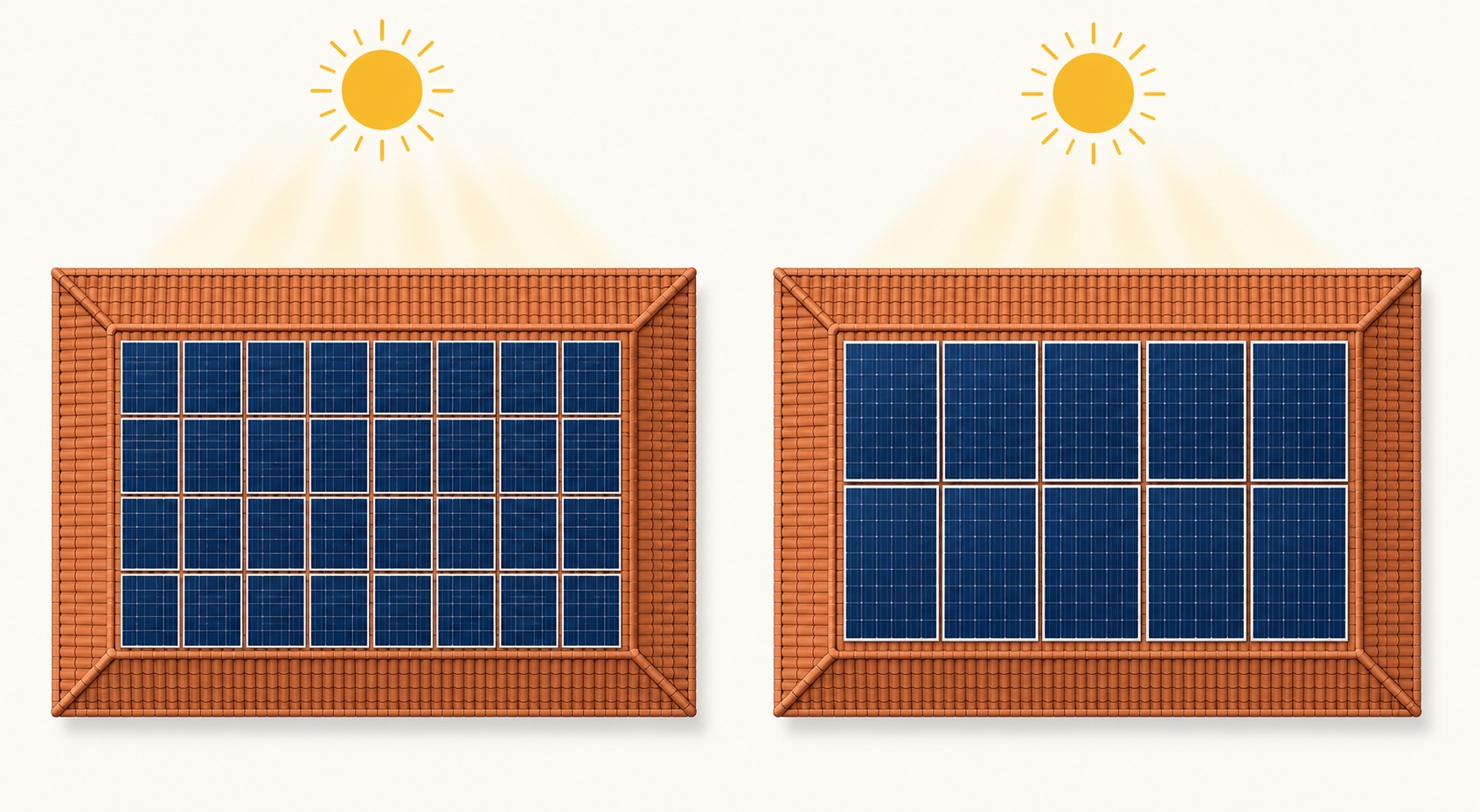
This conceptual illustration shows how panel dimensions and count can change roof fit. It does not compare real products or predict generation.
The Government's solar design guidance also points to roof shape, direction, slope and shade. A neat-looking panel specification cannot compensate for a layout that ignores those conditions. Use the solar shading checklist and the roof orientation guide to review the plan itself.
Do not use efficiency as a quality score
Efficiency says how effectively a panel uses its area. It does not, by itself, tell you how well the panel will hold up, how a warranty claim will be handled or whether the exact model on the quote matches the approved component list.
Check the model number rather than relying on a family or brand name. The Clean Energy Regulator provides the current approved PV module list, while the solar warranty checklist helps separate product, performance and workmanship cover.
Ask the same questions on every quote
Before choosing a design, ask:
- What is the exact panel model, wattage, efficiency and physical size?
- How many panels are included, and what is the total array capacity in kW?
- Can I see a scaled roof layout showing orientation and shaded areas?
- What assumptions were used for the estimated annual generation in kWh?
- Is the quoted model on the current approved component list?
Put those answers beside each proposal. Once efficiency, wattage, dimensions and count are separated, you can compare the roof designs on the same terms without treating one specification as a shortcut for the whole system.
Sources checked
Last reviewed July 2026
This guide is reviewed against current Australian solar policy and market guidance where available. Confirm retailer prices, rebates, and product eligibility before making a purchase decision.
Randy Osifo-Doe is the Brisbane-based founder and lead writer of Aussie Solar Guide. His background is in finance, banking and household budgeting, and he writes from lived experience as a solar homeowner. He is not presented as an engineer, electrician, solar installer or renewable-energy professional.