Grid-Connected vs Off-Grid Solar for Australian Homes
Learn what stays connected, what works in a blackout and which questions to ask before choosing grid-connected, backup-capable or off-grid solar.
 Randy Osifo-Doe
Grid connected vs off grid solar is not simply a choice between having a battery and not having one. A grid-connected home can have solar only, solar with a battery, or a solar-and-battery system designed to supply selected loads during an outage. An off-grid home operates without an electricity network connection at all.
For most Australian homes with an existing grid connection, staying connected is the usual starting point. Off-grid design makes more sense where a reliable network connection is unavailable, unusually difficult or not practical for the property.
What grid-connected solar means
A grid-connected system works alongside the electricity network. Solar can run appliances while the panels are generating. If the home needs more power than the system is supplying, the grid covers the difference. Excess solar may be exported, subject to the property's connection arrangement.
This setup does not require the household to generate and store every unit of electricity it may need. The grid remains available at night, through extended cloudy weather and when household demand is higher than the solar system can supply.
Adding a battery does not make the property off-grid. It can store solar for later use while the home remains connected to the network. The AC-coupled versus DC-coupled battery guide explains two common ways a battery can be integrated with solar.
Why ordinary solar usually stops in a blackout
Many grid-connected solar systems shut down when the network goes out. The Australian Government's battery guidance explains that this automatic anti-islanding behaviour helps prevent a home system from sending electricity into lines while technicians may be working on them.
A battery can provide backup power only when the system and switchboard are designed and configured for it. Some setups back up selected circuits. Others may support more of the home, but the available power and duration still depend on the system design, battery charge and appliances operating at the time.
If blackout backup matters, do not treat the word “battery” as proof. Ask the retailer to identify the backed-up circuits, the maximum backup power and what happens when the battery reaches its reserve level.
What a fully off-grid system needs
An off-grid system, also called a stand-alone power system, has no electricity network connection to fall back on. It must keep the property supplied through nights, poor solar conditions and periods of high demand.
The Australian Government's solar design guidance says these systems need a large battery and control system and often use a backup generator for long cloudy periods. Western Australia's stand-alone power system guidance describes the same core arrangement: solar panels, battery storage, an inverter and backup generation.
That makes off-grid design a whole-property reliability exercise, not just a larger version of a suburban solar quote. The designer needs to understand when electricity is used, which loads are essential, how demand changes by season and what happens after several low-generation days.
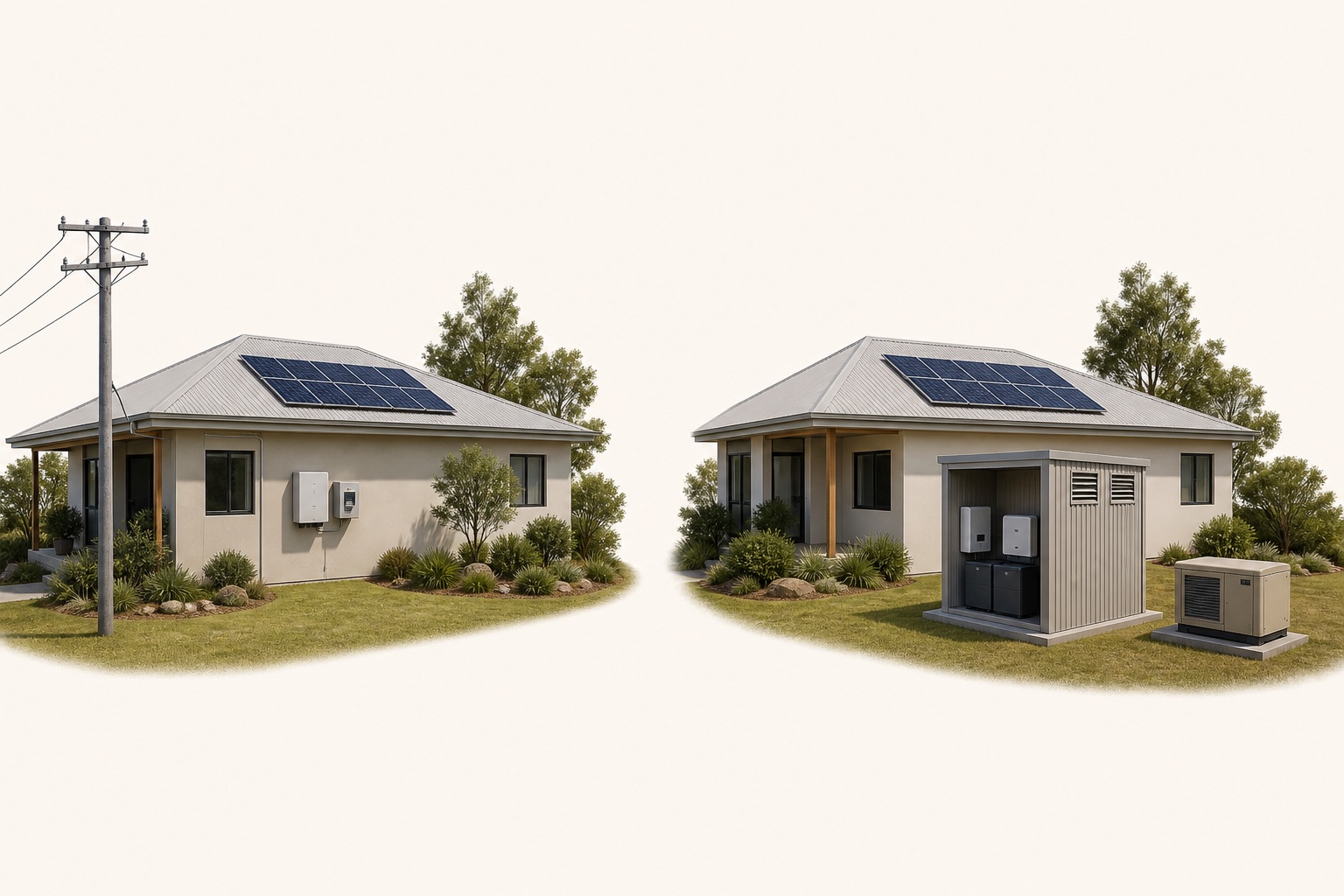
The grid-connected home has a network service line. The off-grid home relies on its own solar, storage, control equipment and backup supply; the illustration is conceptual, not an installation layout.
Compare the three practical options
| Setup | Network connection | Battery | Blackout supply |
|---|---|---|---|
| Grid-connected solar | Yes | Optional | Usually no unless specifically designed for backup |
| Grid-connected solar with backup | Yes | Usually required | Selected or broader loads, according to the design |
| Fully off-grid solar | No | Required | The property's own system is the normal electricity supply |
The middle option is often what people actually mean when they say they want to “go off-grid”: they want lower grid reliance and useful backup, but not necessarily to remove the network connection.
Questions to put into the quote
Before comparing equipment, write down the outcome you need and ask each retailer to answer the same questions:
- Will the property remain grid-connected?
- Which circuits will operate during a network outage?
- Can solar recharge the battery while the grid is down?
- What power can the backup system supply at one time?
- Which large appliances are excluded from backup?
- What operating plan applies through several low-solar days?
- Who will explain the controls, monitoring and shutdown procedure at handover?
Use the battery calculator to organise your daily usage assumptions, then check the difference between power and energy in the kW versus kWh guide. If the main goal is reducing grid purchases rather than surviving outages, the self-consumption and self-sufficiency guide will help you frame that goal more clearly.
The practical next step is to decide whether you need everyday bill support, outage backup or complete independence from the grid. Once that requirement is written down, solar and battery quotes become much easier to compare on the same basis.
Sources checked
Last reviewed August 2026
This guide is reviewed against current Australian solar policy and market guidance where available. Confirm retailer prices, rebates, and product eligibility before making a purchase decision.
Randy Osifo-Doe is the Brisbane-based founder and lead writer of Aussie Solar Guide. His background is in finance, banking and household budgeting, and he writes from lived experience as a solar homeowner. He is not presented as an engineer, electrician, solar installer or renewable-energy professional.