
AC-Coupled vs DC-Coupled Solar Batteries: Quote Guide
Learn how AC-coupled and DC-coupled home batteries connect to solar, and which details to compare on an Australian battery quote.
 Randy Osifo-Doe
AC coupled vs DC coupled solar batteries is becoming a common comparison on Australian battery quotes. The terms describe how the battery, solar panels and inverter are connected—not whether one battery is automatically better than another.
The practical question is whether the proposed design works with your existing solar equipment, future plans, monitoring and backup needs. Ask the retailer to show the complete system path before comparing headline specifications.
Follow the electricity path
Solar panels generate direct current (DC) electricity, while most household appliances use alternating current (AC). An inverter manages the conversion between them.
In an AC-coupled system, the solar inverter first converts panel output from DC to AC. A separate battery inverter can then convert AC back to DC to charge the battery, and convert the battery's DC output to AC when the home uses it. Some batteries include this battery inverter inside the unit.
In a DC-coupled system, the solar panels and battery share a hybrid inverter. Solar DC can charge the battery before the hybrid inverter converts electricity to AC for the home.
The Australian Government's battery guidance describes AC coupling as the usual arrangement when adding a battery to an existing solar system. It notes that either approach can be used when solar and a battery are installed together.
| Quote situation | Useful starting question | Why it matters |
|---|---|---|
| Adding a battery to existing solar | Can the current solar inverter stay? | An AC-coupled design can often work beside existing solar equipment |
| Installing solar and a battery together | Why has this inverter layout been chosen? | A DC-coupled design can combine solar and battery inverter functions |
| Existing microinverters | Which battery connection is compatible? | A hybrid inverter is not a replacement path for a microinverter array |
| Backup is important | Which circuits operate during an outage? | Coupling type alone does not confirm backup operation |
When AC coupling may make sense
AC coupling can be a practical retrofit path because the existing solar inverter can usually remain in service while a battery inverter is added. That can be relevant when the solar system is performing well, the equipment is supported and the proposed battery is compatible with the site.
It also keeps the solar and battery inverter functions in separate devices. Do not assume that means a simpler installation: the quote still needs to account for switchboard space, equipment location, monitoring, network connection and the way the two systems communicate.
If your existing array uses microinverters, read the microinverters versus string inverters guide before comparing battery layouts. The Government's inverter guidance says a hybrid inverter cannot be connected to a microinverter system, so the proposed architecture needs to be clear.
When DC coupling may make sense
DC coupling is often considered when solar and a battery are designed together. A single hybrid inverter combines the solar-inverter and battery-inverter roles, so the installer can plan the panels, battery and inverter as one system.
That does not make every DC-coupled quote the better choice. Compatibility can shape future replacement or expansion options, and the design still has to suit the roof array, battery capacity, household loads and property supply.
Start with the home battery sizing guide rather than choosing a connection type before understanding how much energy and power the household needs. If the property has three-phase supply, the single-phase versus three-phase guide can help you ask which circuits and phases the proposed system will serve.
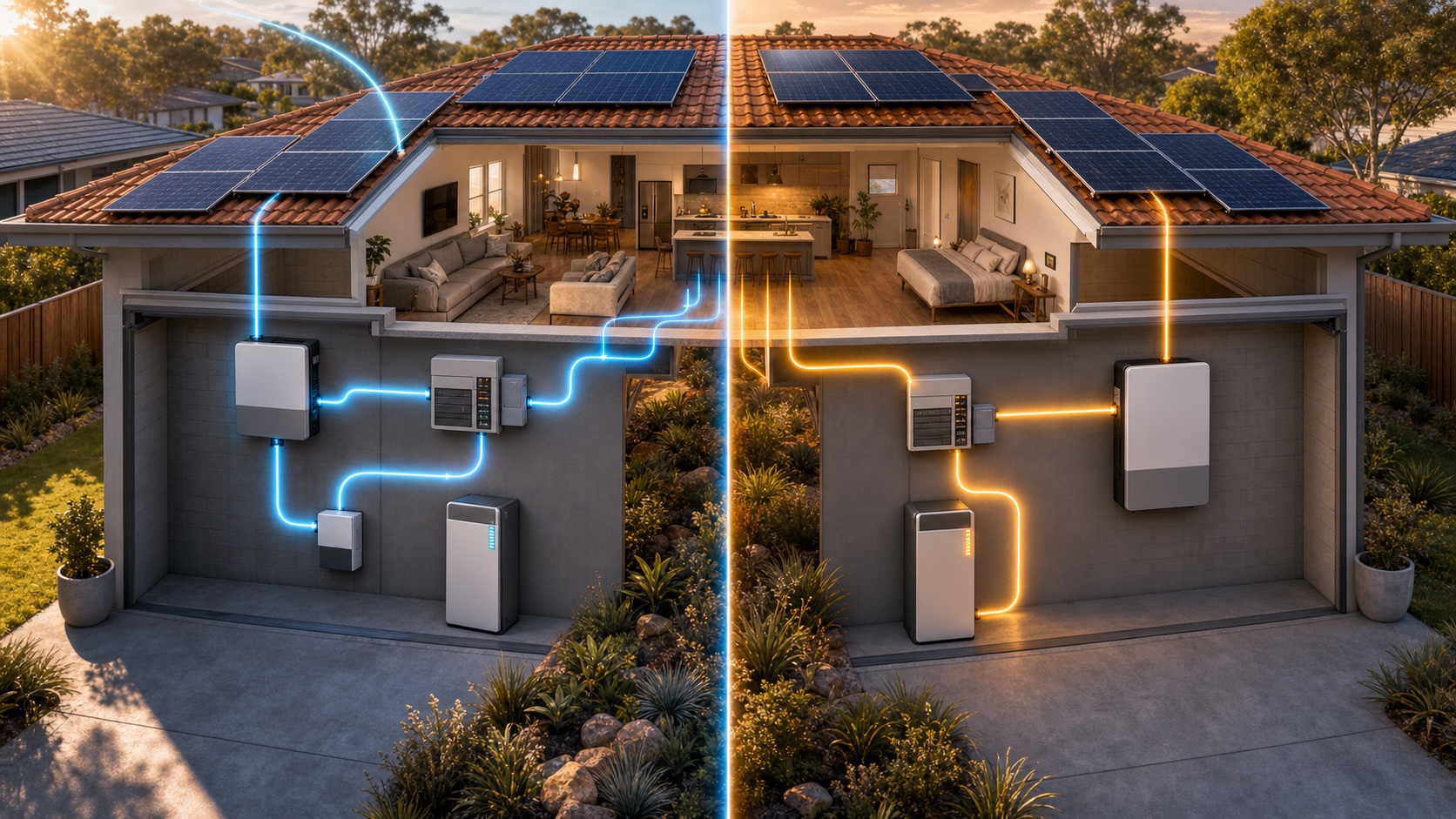
The glowing paths compare a layout with separate solar and battery inverter equipment against one using a hybrid inverter. This conceptual image does not represent a specific product or installation design.
Compare the whole quote
AC or DC coupling is only one design decision. Before accepting a proposal, ask the retailer to put these details in writing:
- Which exact inverter and battery models are included?
- Will any existing solar equipment be retained, replaced or rewired?
- How will solar generation, battery charge and household usage appear in monitoring?
- Does backup require extra equipment, and which circuits will operate during an outage?
- How does the design work with the property's phases, switchboard and network connection?
- Who supports each component and how do the warranties interact?
The Australian Government's solar quote guidance recommends a site-specific design, named equipment, connection information, monitoring discussion and clear warranty details. Use the solar warranty checklist to record who handles each part of a future claim.
Choose between the completed designs, not the coupling label alone. A useful quote should explain why the architecture suits the home and what would change if you keep, replace or expand the solar system later.
Sources checked
Last reviewed July 2026
This guide is reviewed against current Australian solar policy and market guidance where available. Confirm retailer prices, rebates, and product eligibility before making a purchase decision.
Randy Osifo-Doe is the Brisbane-based founder and lead writer of Aussie Solar Guide. His background is in finance, banking and household budgeting, and he writes from lived experience as a solar homeowner. He is not presented as an engineer, electrician, solar installer or renewable-energy professional.