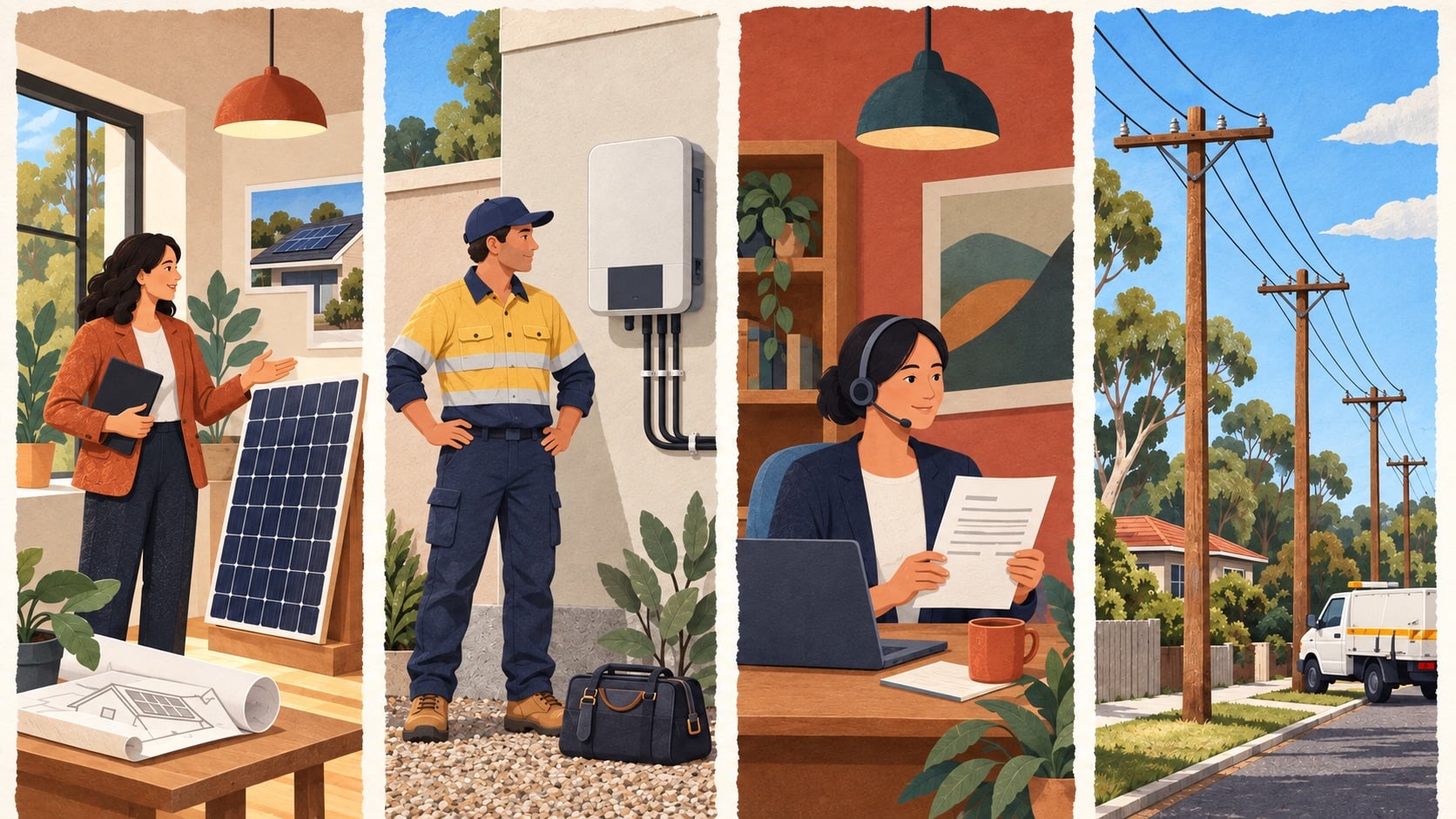
Solar Retailer vs Electricity Retailer: Who Does What?
Know who sold your solar, who installed it, who sends your electricity bill and who runs the network, so you can start with the right contact.
 Randy Osifo-Doe
The solar retailer vs electricity retailer distinction is straightforward: one sells your solar system, while the other manages your electricity account and sends your bills. Your installer and local electricity distributor have different jobs again. Knowing which role you need can save a lot of explaining your question to the wrong team.
You may deal with fewer than four separate businesses, but it still helps to name the four jobs. Start with the solar quote and a recent electricity bill, then build a short contact list around what each organisation actually does.
The solar retailer sells the system
Your solar retailer is the business you buy the panels, inverter and any included battery from. It is the name to identify on the accepted quote or contract, rather than relying on the salesperson's name or the branding on a van.
The Australian Government's retailer and installer guide explains two common arrangements: buying directly from an installer who also sells the system, or buying from a solar retailer that subcontracts the installation.
Ask the seller who will answer questions about the agreed equipment, installation arrangements and after-sales support. Keep that answer with the quote. If something changes before the work starts, use the solar quote change checklist to compare the revised proposal with what you accepted.
The installer does the technical work
The installer fits and sets up the system. That person may work for the business that sold it to you, or for a separate installation business. A different company arriving on installation day does not, by itself, explain whether the arrangement is good or bad. What matters is that the roles and agreed work are clear.
Before installation, ask who will attend and who your day-to-day contact will be. At handover, ask who can help with the monitoring account, operating instructions and technical questions. Our installation day checklist covers those checks in more detail.
I think the useful question is: “If I need help next month, which number should I use?” A named contact is more useful than a general assurance that support is included.
The electricity retailer handles your account
The electricity retailer is the company named on your electricity bill. Its role concerns your electricity supply account, billing and related enquiries, rather than the physical installation of the panels.
The Australian Energy Regulator's contact guide directs customers to their electricity retailer for bill questions, electricity metering enquiries and arranging supply. If you are asking about a line on your bill, start with that retailer and have the bill available.
Keep the two sets of records separate. Your solar purchase documents describe the system you bought. Your electricity bills describe your energy account. A conversation about one does not automatically settle a question about the other.
The distributor runs the local network
The distributor owns and maintains the local electricity network, including the poles and wires that carry electricity to homes. It is a different role from sending your bill or installing your panels.
The AER directs network, outage and supply-quality enquiries to the distributor. You can identify yours from your electricity bill, ask your retailer, or use the AER distributor directory.
For a new solar connection, start with the solar seller or installer coordinating the job and ask which organisation is handling the next step. Our guide to solar installed but not switched on explains that particular process without treating every delay as an equipment fault.
Match the question to a first contact
This is a starting guide, rather than a promise that one organisation will handle every part of an issue.
| Your question | Useful first contact |
|---|---|
| What equipment did I agree to buy? | Solar seller named on the quote |
| Who will attend or explain the handover? | Agreed installation contact |
| Why is this item on my electricity bill? | Electricity retailer on that bill |
| Is there a network outage in my street? | Local electricity distributor |
| Who can check a problem with the installed solar? | Company that sold you the system |
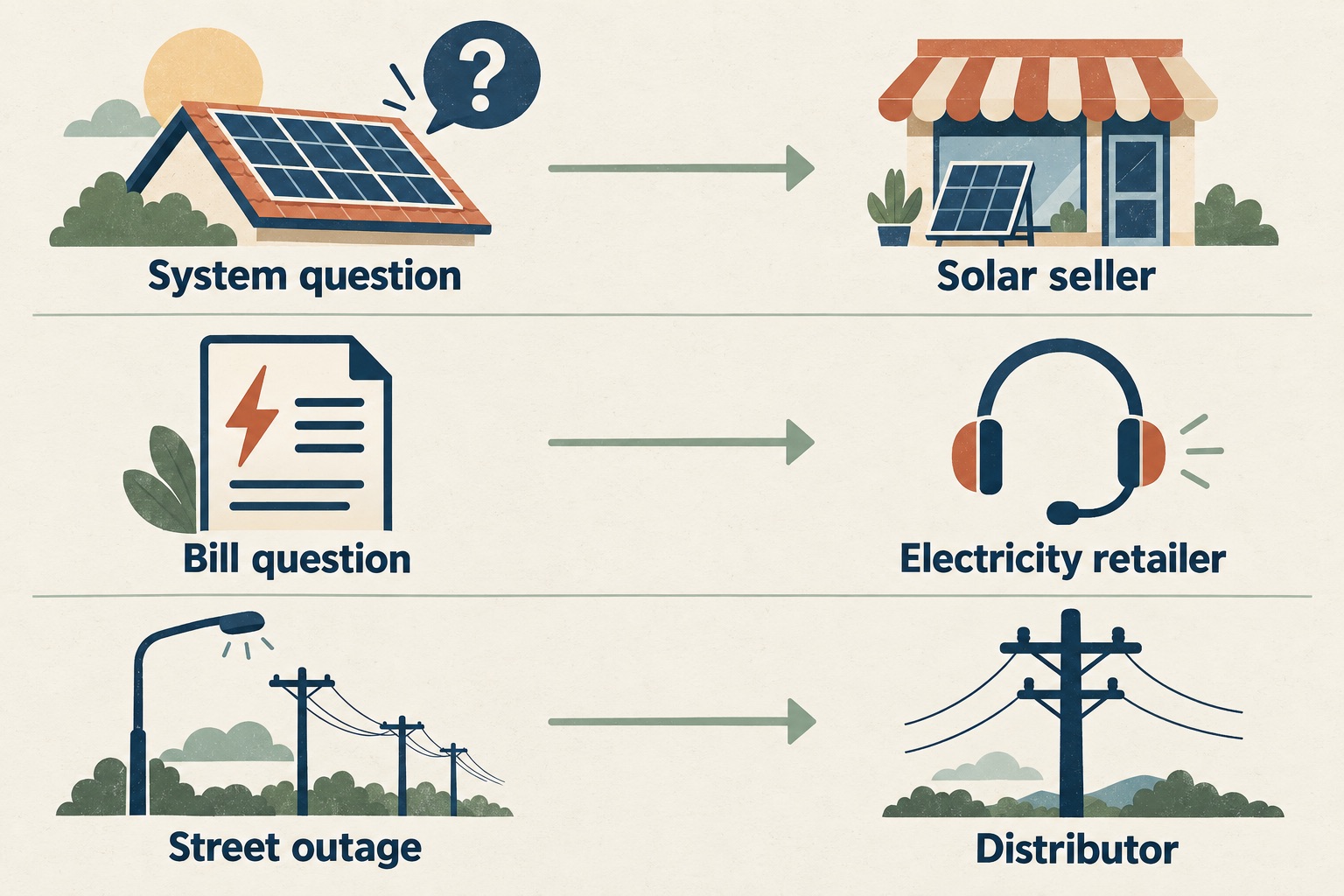
Choose a first contact based on the question. The illustration summarises roles; it does not assign legal responsibility.
The government's installation and aftercare guidance recommends contacting the company that sold you the system first if it is not working as expected after switch-on. Describe what you have observed rather than trying to diagnose it yourself.
Make the next conversation easier
Save each business name, role, phone number and email address in one household note. Add the solar quote reference and electricity account reference beside the relevant contact, so they do not get mixed up.
When following up, give the date, the question and any existing reference number. If another team needs to help, ask for its name and the specific next step. You don't need to learn the whole electricity industry. You need a clear starting point and a record of who is doing what.
Last reviewed September 2026
This guide is reviewed against current Australian solar policy and market guidance where available. Confirm retailer prices, rebates, and product eligibility before making a purchase decision.
Randy Osifo-Doe is the Brisbane-based founder and lead writer of Aussie Solar Guide. His background is in finance, banking and household budgeting, and he writes from lived experience as a solar homeowner. He is not presented as an engineer, electrician, solar installer or renewable-energy professional.