
Battery Rebate Reduction: What Homeowners Should Check Now
The federal battery discount is still available, but the May 2026 factor and size tiers changed what different battery capacities receive.
 Randy Osifo-Doe
The battery rebate reduction that started on 1 May 2026 did not close the Cheaper Home Batteries Program. The federal discount is still available for eligible systems, but the STC factor is lower and larger batteries now receive progressively less support per extra kilowatt-hour.
For homeowners comparing quotes now, the practical task is not to chase the biggest battery or an expired deadline. It is to check that the installer has used the current factor, applied the capacity tiers correctly, and matched the battery to your solar surplus, evening usage and backup needs.
What changed on 1 May 2026
The Australian Government changed two parts of the calculation:
| Setting | January-April 2026 | May-December 2026 |
|---|---|---|
| STC factor | 8.4 per eligible kWh | 6.8 per eligible kWh |
| Capacity treatment | One factor across eligible capacity | Full factor to 14 kWh, 60% from above 14 to 28 kWh, then 15% from above 28 to 50 kWh |
The installation and certification date determines which factor applies. Paying a deposit earlier does not preserve the previous setting if the battery was installed after the change.
DCCEEW says the program is intended to keep the discount at around 30% for a range of battery sizes. That is a program-level guide, not a promise that every household will see exactly 30% off its total installed quote.
How the size tiers affect the discount
The strongest support now applies to the first 14 kWh of usable capacity. The next 14 kWh receives 60% of the factor, while usable capacity above 28 kWh and up to 50 kWh receives 15%.
This means a larger battery can still receive more STCs overall, but each extra kilowatt-hour above the thresholds adds less support. Bigger is not automatically worse; it simply needs to solve a real household need rather than being selected mainly for the discount.
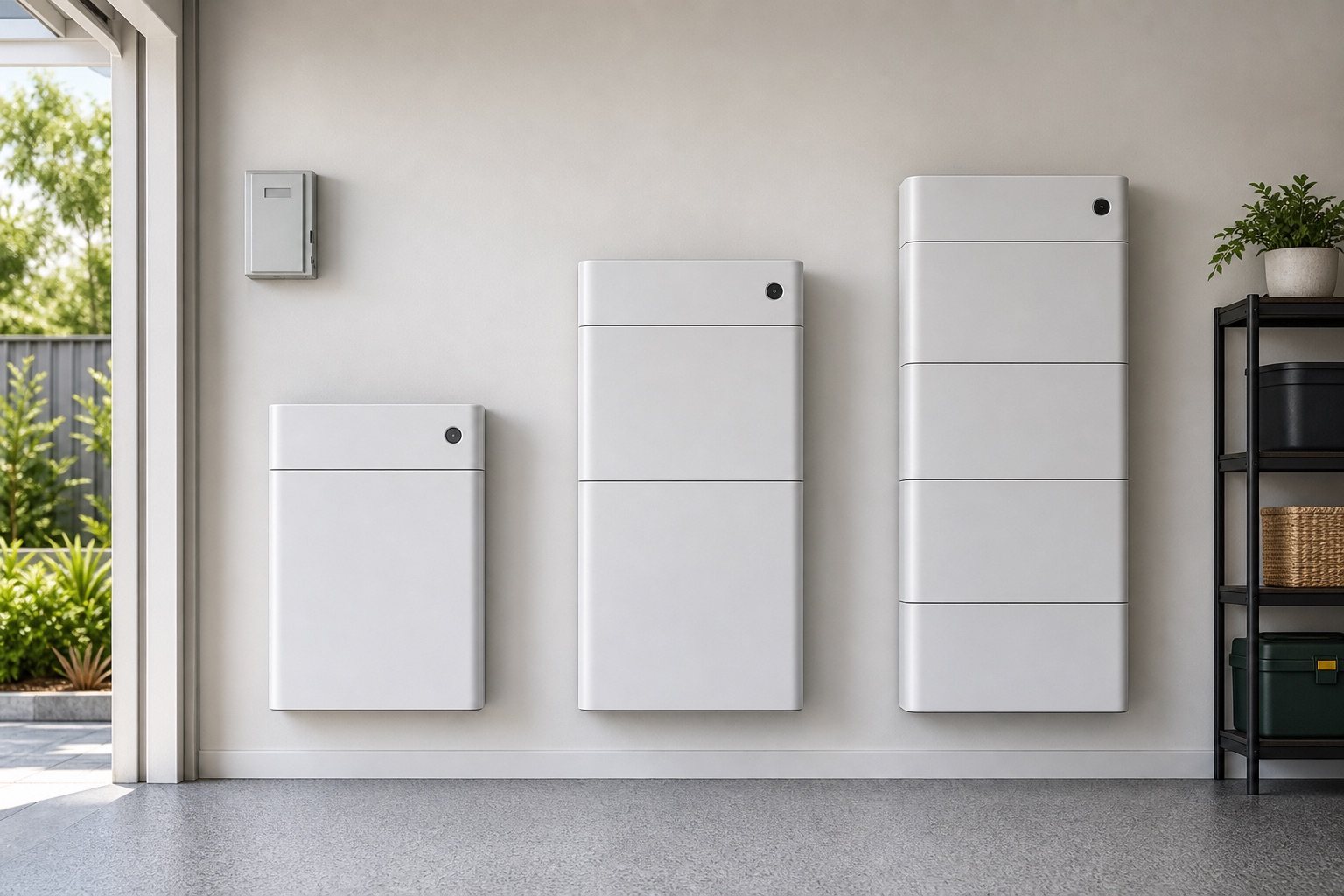
Battery systems can be expanded with additional modules, but the federal support rate tapers as usable capacity moves above 14 kWh and 28 kWh. The equipment shown is illustrative and not a product recommendation.
An indicative STC comparison
The table below illustrates the federal calculation using usable capacity and the published factors. STCs are rounded down. It does not estimate your final installer discount.
| Usable battery capacity | Before 1 May at factor 8.4 | From 1 May at factor 6.8 and tiering |
|---|---|---|
| 10 kWh | 84 STCs | 68 STCs |
| 14 kWh | 117 STCs | 95 STCs |
| 28 kWh | 235 STCs | 152 STCs |
| 50 kWh | 420 STCs | 174 STCs |
DCCEEW states that the STC Clearing House price is fixed at $40 per certificate, excluding GST. However, an installer or retailer may use an open-market value and include administration fees. Ask for the certificate count, assumed value per STC and resulting discount to be itemised in writing.
Does a smaller battery now make more sense?
Sometimes, but not always. A battery should first be sized around the energy you can regularly put into it and use later.
A system around the common household range may suit homes with moderate evening demand. A larger battery may still be reasonable for high night-time usage, an electric vehicle, electric heating, backup requirements or a large solar array with substantial daytime exports.
Before accepting the recommendation, compare the proposed usable capacity with:
- your typical evening and overnight consumption
- the solar energy available after daytime household use
- the backup reserve that will remain unavailable for daily cycling
- inverter and battery charge or discharge limits
- warranty throughput and expected degradation
- any virtual power plant conditions
Use the battery calculator to test capacity against your usage, then check the support separately with the rebate calculator.
What to ask the installer to itemise
Ask every installer to show:
- Nominal and usable battery capacity.
- The installation date assumed for the STC factor.
- Capacity receiving the full, 60% and 15% factor treatment.
- The number and value of STCs assigned to the installer.
- Any administration fees deducted from the certificate value.
- Hardware, installation, switchboard and backup-circuit costs separately.
- Product approval, installer accreditation, warranty and connection requirements.
The Price Explorer can help you review the whole quote rather than judging it by one rebate line. When you are ready to compare itemised proposals, the quote request flow keeps rebate and hardware assumptions visible.
Bottom line
The May 2026 change reduced the support available per kilowatt-hour, particularly for capacity above 14 kWh. It did not make home batteries ineligible or automatically poor value.
The sensible response is to slow the sizing decision down. Confirm the current STC calculation, compare usable capacity with your real energy profile, and judge the final installed price and warranty together.
Sources checked
Last reviewed July 2026
This guide is reviewed against current Australian solar policy and market guidance where available. Confirm retailer prices, rebates, and product eligibility before making a purchase decision.
Randy Osifo-Doe is the Brisbane-based founder and lead writer of Aussie Solar Guide. His background is in finance, banking and household budgeting, and he writes from lived experience as a solar homeowner. He is not presented as an engineer, electrician, solar installer or renewable-energy professional.