
Daily Supply Charges After Solar: What Proposed Changes Could Mean
Supply charges still matter after solar. This guide explains the proposed changes and the checks to make before reacting.
From "Use Less, Pay Less" to "Just Pay More"
For the past decade, the logic of home energy was beautifully simple: the less electricity you drew from the grid, the lower your bill. Solar panels, batteries, and energy-efficient appliances all pointed in the same direction. Good on ya for doing the right thing.
The AEMC's Pricing Review wants to flip that logic on its head.
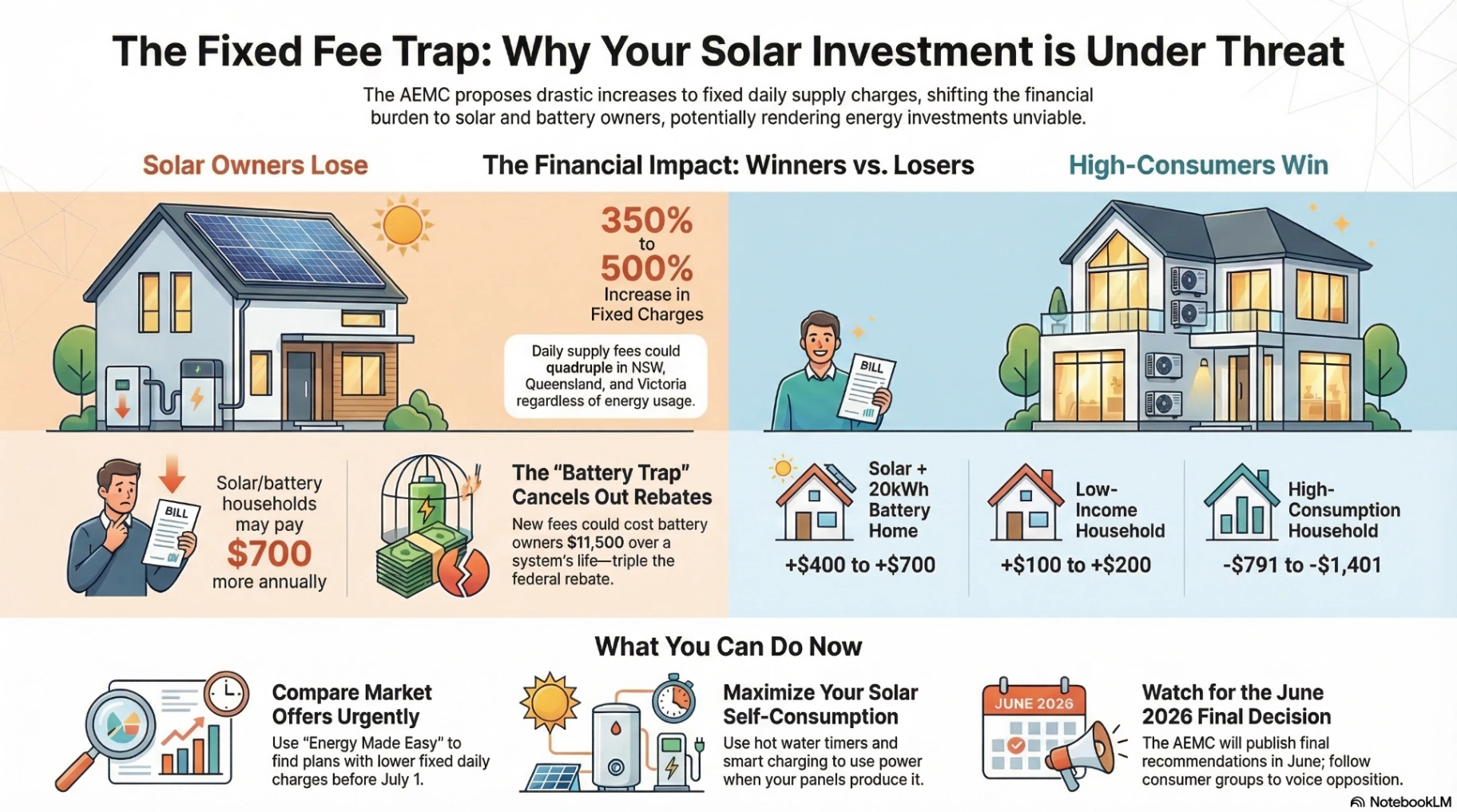
The proposal could involve roughly a quadrupling of the network fixed charge, from around a 350% increase in NSW and Queensland networks, to a 500% increase in Victorian networks. Instead of paying based on what you actually consume, you'd be slugged a hefty flat fee simply for being connected to the grid. Doesn't matter if you barely touch it.
Currently, fixed network charges make up roughly 39% of a typical electricity bill. Under the new model, that share would balloon, and your ability to shrink it would effectively disappear.
The Numbers That Should Make You Angry
Let's put some real figures to what this actually means for your hip pocket.
Independent modelling by Green Energy Markets found that a household with an 8kW solar system and a 20kWh battery could see their electricity bill increase by around $400 to $700 per year as a result of the AEMC proposal.
But that's just the short-term hit. The AEMC's proposal could add $5,800 to $11,500 in costs over a 10kWh battery's lifetime, more than cancelling out the benefit from federal government rebates. The federal Cheaper Home Batteries Program offers around $3,300 back. In a worst-case scenario, this fixed charge shift could cost battery owners nearly three times that rebate over the life of their system. You do the maths.
Meanwhile, a high-income, large-consumption household would be a major winner, with annual bill reductions ranging between $791 in some networks to as much as $1,401 in others.
Read that again. The households smashing through electricity like it's going out of fashion would pay less. The ones who've done the hard yards and invested their own money to use less would pay more. Mate.
Who Gets Hit Hardest
Solar and battery owners are the obvious target. You've minimised your grid consumption, so the new fixed fee hits you hardest relative to what you were previously paying.
Low-income and low-consumption households are arguably in an even worse spot. Low-income households are estimated to end up between $100 and $200 worse off per year. The brutal irony is that many of these households keep their bills low precisely because they have to, through careful habits, smaller homes, and fewer appliances. Under a fixed-charge model, that discipline becomes financially worthless.
Renters and apartment dwellers face a double whammy. They can't install solar to offset the rising costs, and they tend to use less power anyway, which is exactly the profile that gets squeezed the most under this model.
Fixed charges don't just raise bills. They flatten incentives. When a large part of your electricity bill becomes unavoidable, there's little reason to change your behaviour or invest thousands in solar and batteries to use less grid electricity.
The "We're Just Being Fair" Argument
The AEMC frames this as equitable cost-sharing. Their position is that where electricity once flowed in one direction, it now flows in two, and their reforms would ensure everyone who relies on the grid contributes fairly to maintaining it.
The network companies, the poles and wires businesses, argue that solar and battery owners use so little grid power that they've effectively become free riders, benefiting from grid stability and backup power without paying their share to keep it running.
It's a coherent argument on paper. The problem is the data doesn't support the proposed fix.
The Smart Energy Council notes that this is a self-initiated review by the AEMC, yet the most consequential proposal, a shift toward predominantly fixed network charges, was not referred to the Stakeholder Reference Group and is not supported by published bill modelling or real-world evidence.
Australia now has over 4.2 million rooftop solar systems installed, with Australian households and small businesses investing well over $25 billion of private capital in these systems. The AEMC's proposal effectively treats those Australians not as partners in the energy transition, but as a problem to be managed.
The Bitter Irony: This Kills the Battery Rebate
The timing couldn't be worse. The federal government launched its Cheaper Home Batteries Program to accelerate battery uptake, essentially betting that more home storage would take pressure off the grid and lower costs for everyone.
Higher fixed charges would instead discourage people from trying to reduce their energy use and from installing solar panels or batteries, running counter to initiatives like the Solar Sharer Offer and the federal home battery rebate, which encourage the use of cheaper renewable power in our homes.
So one arm of the government is subsidising batteries, while another may be about to eliminate the financial reason to own one. You couldn't make it up.
What Happens Next
Here's the timeline to keep in your back pocket:
- 13 February 2026 — Deadline for written submissions (a big volume came in)
- June 2026 — AEMC publishes its final recommendations
- 2026 onwards — Implementation commences, with full rollout extending to the mid-2030s
This isn't happening overnight. The June report is recommendations, not law. Any changes still require further regulatory work before they take effect. But once fixed charges rise, they historically don't come back down. That's worth keeping in mind.
What Can You Actually Do Right Now
Compare market offers urgently. Regardless of what the AEMC decides, the 2026-27 Default Market Offer resets on 1 July. This is your annual window to lock in a better deal. Jump on Energy Made Easy and compare what's available in your postcode. If you're a low-usage household, look specifically for plans with lower fixed daily charges.
Maximise your self-consumption now. While the usage rate still matters, make sure you're getting the most out of what your panels and battery produce. Hot water timers, smart EV charging schedules, and shifting your heavy appliances to daytime hours all make a genuine difference.
Know your numbers before you ring your retailer. Download your last 12 months of usage data from your online account. When you call to negotiate, you'll know exactly what a fair deal looks like, and they'll know you know it too.
Stay across the AEMC outcome. Keep an eye on the AEMC's project page and follow Solar Citizens for updates. If the June final report recommends proceeding, there will be further consultation before it takes effect, and consumer voices will matter in that process. Make yours heard.
The Bottom Line
The AEMC's proposal isn't a minor technical tweak. It's a structural redesign of who pays for Australia's electricity grid, and as currently proposed, it shifts the burden onto exactly the households that have done the most to reduce their reliance on it.
If you've invested in solar or a battery, this is the policy story of 2026. Watch the June final report closely, because by the time most people realise what's changed, it'll already be locked in.
Want to know how your specific system would be affected? Get in touch for a free energy review and we'll model your numbers under the proposed new tariff structure.
Last reviewed May 2026
This guide is reviewed against current Australian solar policy and market guidance where available. Confirm retailer prices, rebates, and product eligibility before making a purchase decision.
Aussie Solar Guide Editorial Team
Our team of solar energy researchers and writers are dedicated to providing independent, consumer-focused advice for Australian homeowners. We analyse the latest industry data, government policies, and technology developments to help you make informed decisions about solar energy.