Can Your EV Power Your Home? V2H and V2G in Australia in 2026
V2H and V2G are moving beyond small trials in Australia, but compatibility remains limited. Learn what to verify before relying on an EV to power a home or support the grid.
 Randy Osifo-Doe
V2H and V2G in Australia are becoming serious energy technologies, but they are not yet a universal plug-and-play replacement for a home battery. Australia is moving from small demonstrations towards larger trials, while vehicle support, warranties, bidirectional charging equipment and electricity arrangements still vary.
That makes 2026 an important year to watch, not a reason to assume every new electric vehicle can run a house. The useful question is whether the complete system — car, charger, switchboard, software and energy plan — works together for the job you want it to do.
V2H, V2G and V2L are different
These terms describe different ways an electric vehicle can send electricity out of its battery:
- Vehicle-to-home (V2H) can supply electricity to a home through compatible bidirectional equipment. It may help cover household loads or provide backup power when the system is designed for that purpose.
- Vehicle-to-grid (V2G) can export electricity through an approved bidirectional device. Depending on the electricity arrangement, the vehicle may respond to grid needs or electricity prices.
- Vehicle-to-load (V2L) powers appliances or equipment from an outlet on the vehicle. It does not automatically connect the car to the home's electrical system.
The Australian Government's EV definitions say V2H and V2G require compatible equipment and manufacturer warranty or service support. A vehicle having V2L does not prove that it supports V2H or V2G.
Why this became a 2026 tech trend
The clearest signal is the scale of current Australian work. In May 2026, the Australian Renewable Energy Agency announced an expansion of a vehicle-to-grid project from 50 to 1,000 participating homes. The project is intended to test technology integration, customer experience and warranty support at a larger scale.
The Australian Government also highlighted the expansion in its June 2026 update on support for driveable home batteries. This is meaningful progress, but a funded rollout is not the same as universal retail availability. It should be read as evidence that the market is developing and that important practical questions are still being worked through.
What has to line up at your home
Bidirectional charging is a system decision rather than a single-product decision. Before treating an EV as part of your home energy setup, ask for written answers across the whole chain.
| Part of the system | What to verify |
|---|---|
| Vehicle | Does the exact model and software version support the intended V2H or V2G function in Australia? |
| Manufacturer support | Is that use covered by the current Australian warranty and service documentation? |
| Bidirectional equipment | Is the device compatible with the vehicle and suitable for the intended connection? |
| Home electrical setup | What switchboard, metering, backup or phase-related work is required at this property? |
| Energy arrangement | Which retailer, network or program conditions apply to importing, exporting or being paid? |
| Driving routine | Will the vehicle usually be connected when the home or grid needs the stored energy? |
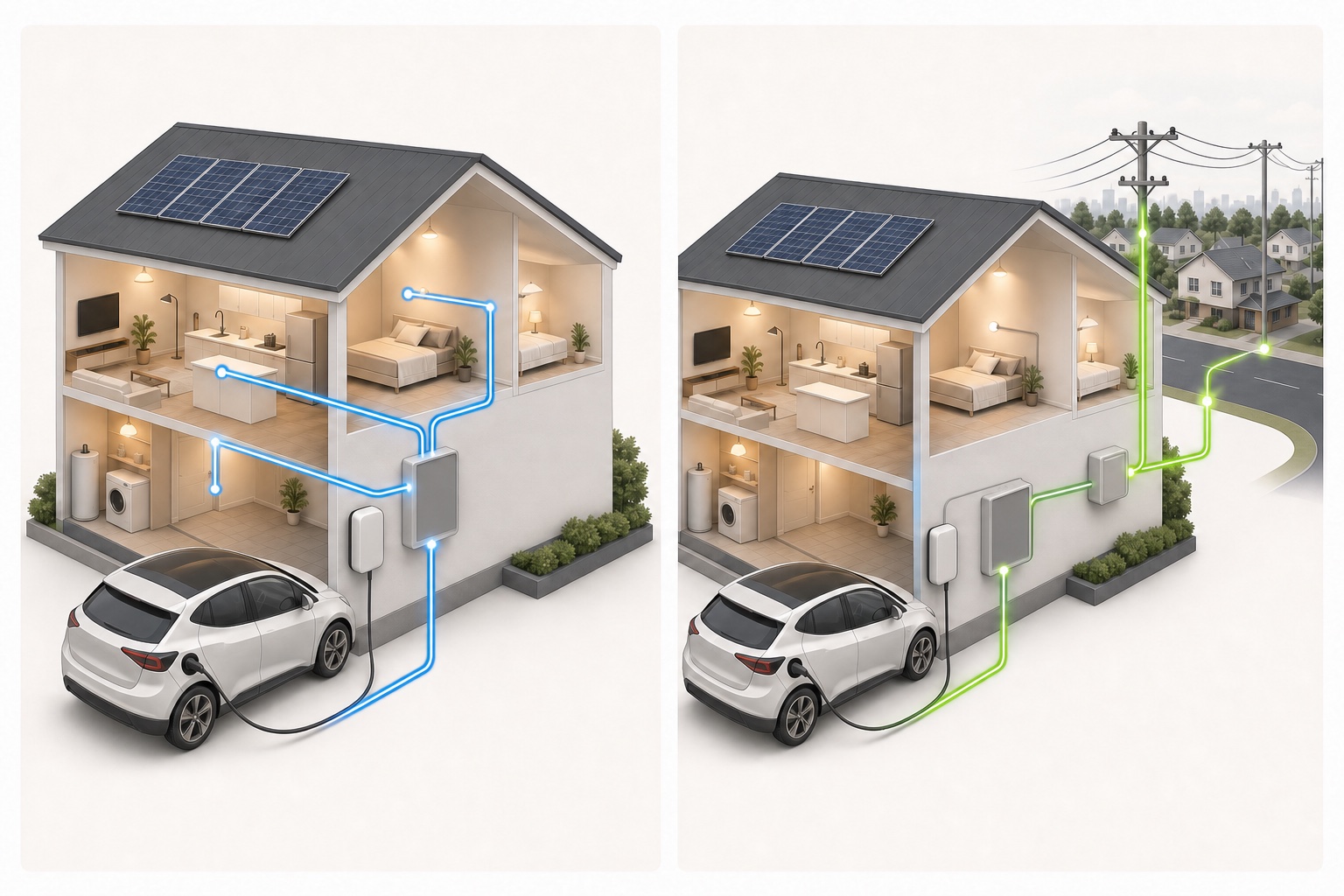
This simplified illustration shows the basic direction of energy flow. Actual equipment, connections and control arrangements vary.
The Government's current vehicle-to-everything guidance says very few EVs in Australia presently have manufacturer-confirmed V2X capability. It recommends checking the vehicle specifications, manufacturer documentation, warranty and charger compatibility. Those checks should be repeated for the exact model and current software, not inferred from overseas capability or another variant.
How rooftop solar changes the decision
Solar can charge an EV from daytime generation, and bidirectional capability may later return some stored energy to the home. The practical value depends on when the car is at home, how much energy remains after driving, household demand and any minimum reserve you want to keep in the vehicle.
Start by separating power from energy using the kW versus kWh guide. Then check how the proposed equipment fits the existing system, including whether it is AC-coupled or DC-coupled and whether the property has single-phase or three-phase power.
Do not assume a large EV battery guarantees large savings. Electricity prices, export terms, charging losses, availability and extra battery cycling can all affect the outcome. The Government guidance specifically notes that additional cycling may increase battery wear.
Questions to ask before relying on it
Use the same checklist with the vehicle seller, equipment supplier and electrician:
- Which V2H or V2G function is supported for this exact Australian vehicle model today?
- Where is that support stated in the manufacturer warranty or service documents?
- Which bidirectional device and software version are compatible, and what approvals apply?
- Will the proposed system power the home during an outage, or only operate while the grid is available?
- What switchboard, metering, internet or energy-plan requirements are excluded from the quote?
- How will minimum driving range, charge limits and battery cycling be controlled?
- What happens if the vehicle, charger software, retailer program or warranty terms change?
The ARENA national roadmap identifies consumer value, smart-grid integration, interoperability, standards and policy as connected parts of commercial adoption. That is why one compatible component is not enough.
The practical bottom line
V2H and V2G are worth watching closely in 2026, especially if an EV purchase and a home energy upgrade are both on your horizon. For most households, the safe approach is to verify current Australian support in writing before designing the rest of the system around the vehicle.
You can use the battery calculator to explore household energy patterns, but it does not confirm EV or charger compatibility and should not be treated as a savings forecast. Keep the vehicle's transport role, backup needs and grid participation separate until a supplier can show how the complete system handles each one.
Sources checked
Last reviewed August 2026
This guide is reviewed against current Australian solar policy and market guidance where available. Confirm retailer prices, rebates, and product eligibility before making a purchase decision.
Randy Osifo-Doe is the Brisbane-based founder and lead writer of Aussie Solar Guide. His background is in finance, banking and household budgeting, and he writes from lived experience as a solar homeowner. He is not presented as an engineer, electrician, solar installer or renewable-energy professional.