
Solar and Batteries During Energy Price Spikes: What Australian Homes Should Check
Solar and batteries can reduce grid exposure for some homes. Check usage, tariffs, backup goals and quote assumptions first.
If you've opened your electricity or gas bill recently and felt a pit in your stomach, you're not alone. As we move through early 2026, Australian households are feeling the full force of two coinciding energy shocks: the official end of federal energy credits in December 2025, and continued extreme volatility in global gas prices.
The End of Credits, the Era of "Full Price Power"
For the last couple of years, government bill credits quietly masked the real cost of energy. Those supports are now gone, and average household bills in Queensland are reflecting the harsh reality. In South-East Queensland, peak grid power is now frequently hitting 30c to 40c per kWh, driven by both domestic network maintenance costs and our deep reliance on gas-fired generation to fill the critical evening gap.
If you want to see exactly how much you could be saving by going solar right now, our Solar Savings Calculator runs the numbers based on your location, usage, and system size. It only takes a couple of minutes.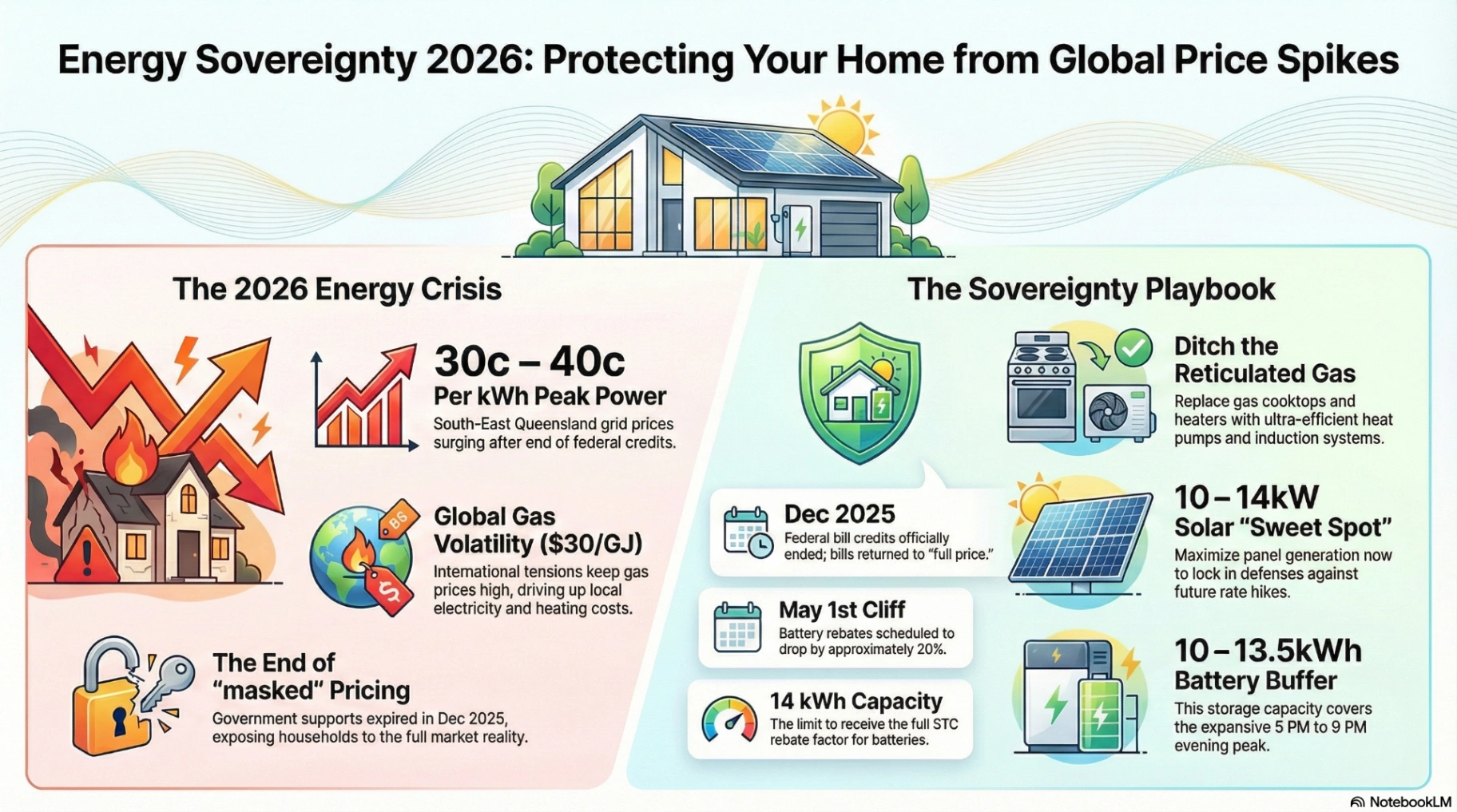
Global Gas Instability Hits Home
Despite Australia's status as one of the world's largest Liquefied Natural Gas (LNG) exporters, our domestic gas prices are intricately linked to global spot prices. Recent international tensions, including ongoing conflicts affecting major global shipping routes, have kept international spot prices aggressively high, frequently pushing above $30/GJ. Every time there is a spike on the global market, Australian gas and electricity prices face upward pressure, as local producers seek to match international returns.
Just this week, the Australian Energy Market Operator (AEMO) released its March 2026 Gas Statement of Opportunities (GSOO). The report made one thing crystal clear: while immediate winter shortfalls have been delayed, it's only because households adopting batteries and electrification are doing the heavy lifting. The grid still relies heavily on expensive gas to keep the lights on after sunset. For homes still relying directly on reticulated gas for hot water and cooking, this dependency is now exceptionally expensive.
Total Electrification: Your Geopolitical Defence
This is where Solar and Battery storage in 2026 must be understood differently. Your system isn't merely a new appliance. It is a deliberate strategy for achieving genuine household energy sovereignty.
By combining a large solar array with powerful energy storage, you are effectively decoupling your home from global volatility. When your house runs on sunshine harvested from your own roof in Wellington Point or Manly or Redland Bay, you are immune to price spikes driven by distant geopolitical events. Wars overseas can't stop the Queensland sun from shining.
The 2026 Sovereignty Playbook
Total energy sovereignty requires a real commitment to electrification. Here is how you lock in your independence.
Ditch the Gas. Gas hot water systems, gas cooktops, and gas space heating need to go. Replace them with ultra-efficient heat pumps and induction cooktops. A modern heat pump hot water system uses roughly a third of the energy of a gas equivalent and can be run entirely on your midday solar surplus.
Solar for Generation. Install as much high-efficiency solar as your roof can accommodate. With the May 1st Rebate Cliff fast approaching, after which battery rebates drop by roughly 20% and tiered reductions apply to systems over 14 kWh, maximising your panel count now is your strongest defence against future rate hikes. The sweet spot for most Brisbane households is in the 10 to 14 kW range.
Battery for Independence. Ensure your system includes powerful, VPP-ready storage. A 10 kWh to 13.5 kWh battery is more than capable of running a fully electrified Queensland home through the expensive 5 PM to 9 PM evening peak. Critically, that size range sits entirely within the 14 kWh threshold that receives the full STC rebate factor, even after May 1st.
EV as a Buffer. If you own an electric vehicle, configure your smart charger to fuel up primarily from surplus midday solar. You're now driving on Queensland sunshine, and you've cut the petrol station out of your budget entirely.
Achieving this level of self-sufficiency requires an upfront investment, but with standard grid power bills escalating to historic highs and global energy instability looking like the new normal for the foreseeable future, it is a defensive strategy your household cannot afford to ignore.
Not sure where your numbers land? Run your system through our free rebate calculator to see exactly what federal incentives are still available before the May cliff, and what your potential annual savings look like before and after the changeover.
This is the only path to genuinely taking back control and securing long-term energy sovereignty for your Australian home.
Last reviewed May 2026
This guide is reviewed against current Australian solar policy and market guidance where available. Confirm retailer prices, rebates, and product eligibility before making a purchase decision.
Aussie Solar Guide Editorial Team
Our team of solar energy researchers and writers are dedicated to providing independent, consumer-focused advice for Australian homeowners. We analyse the latest industry data, government policies, and technology developments to help you make informed decisions about solar energy.